Verify the dig point. Protect the system.
A final check before every excavation around power, gas, water, and telecom, run by the crew on site.
Where it fits
One scan at the dig point, after the marks are down and before the bucket goes in.
Demonstrated with utilities including NextEra Energy, FirstEnergy, BGE, National Grid, and Enbridge.
Maintenance and repairs
Check the ground before opening it around existing plant.
System upgrades
Confirm conditions when working around active or unknown lines.
Emergency response
A scan in seconds when time is short and conditions are uncertain.
Congested corridors
Work with more confidence where lines overlap or records are thin.
Re-excavation
Reconfirm the ground when returning to previously disturbed areas.
Why it matters here
Marks are not the ground
Locates are read from records. The scan reads what is actually there, at the point of dig.
Service stays on
A strike on a feeder or a main takes customers down. The check costs seconds.
Proof of due diligence
Every scan is recorded with position, time, and operator.
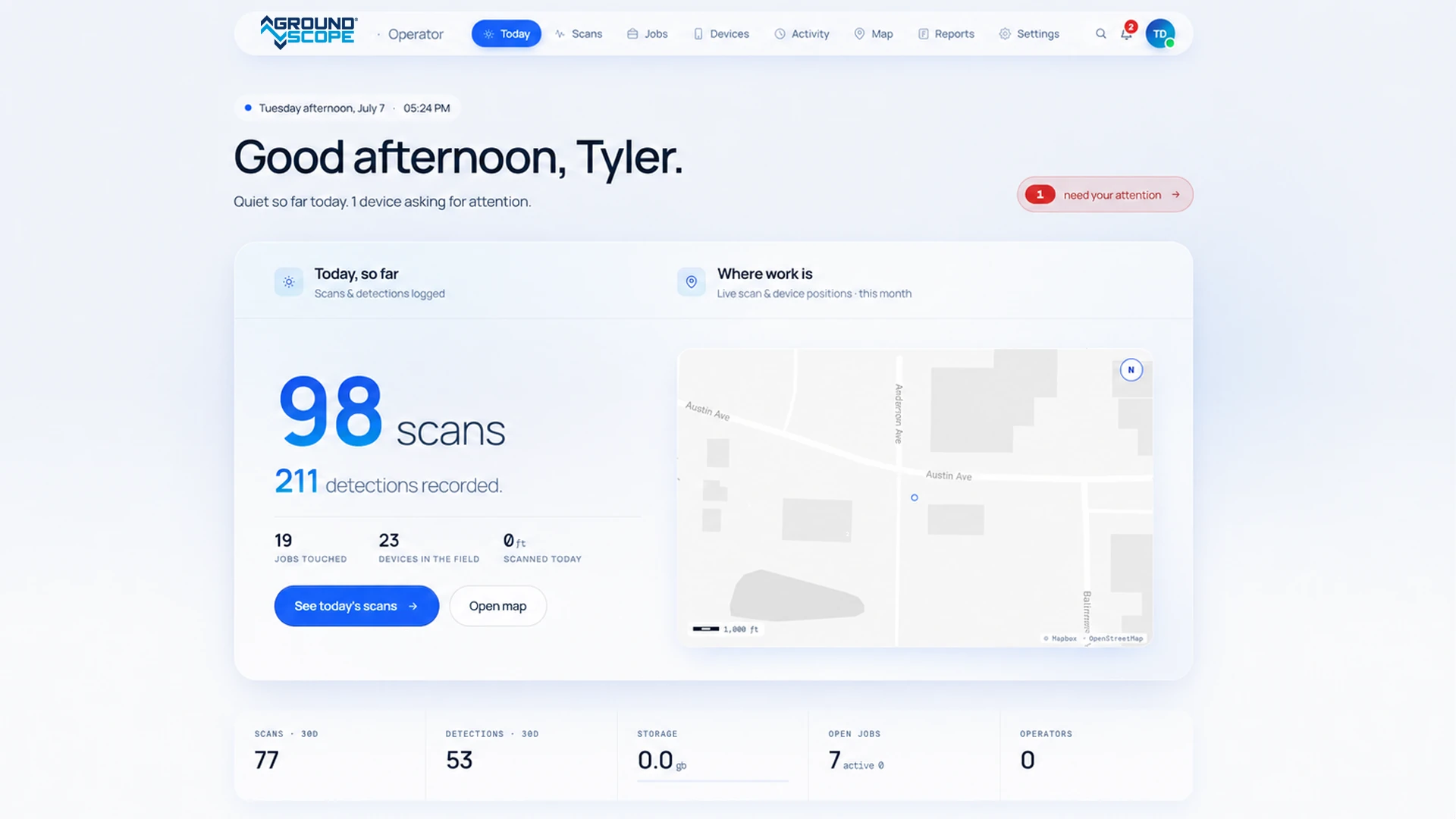
Every scan becomes an official record
The moment a scan finishes it is stored in the GroundScope Portal with its position, time, operator, and unit.
If a strike is ever questioned, the record of the check is there.
Everything you need to know
When should GroundScope be used in utility work?
After 811 markings and before excavation begins, to verify conditions at the point of dig. It can also be used through a job as conditions change.
Does GroundScope replace utility locating services?
No. It adds a verification step after the marks are down.
How quickly do crews get results?
In seconds, on the tablet, with no specialist to interpret the scan.
Can it be used in congested utility areas?
Yes. It is most useful where infrastructure is dense or poorly documented.
Who operates it?
The crew. Most operators learn the workflow in about ten minutes.